
Being active. A lifestyle that seems harder and harder every month.
In this society and time period, most of us spend hours behind a desk, on the couch, and in bed, and not so many hours being active.
Where can we find the time?
We are always busy. Running around doing errands, trying to finish the time-sensitive projects we took on, and trying to make money to make a living.
What if I told you being active is the simplest way to gain more energy, focus, and well-being?
Yep, that’s right, it has all those benefits and MORE.
This post will show how just a little more activity, with minimal effort, leads to big benefits.
Benefits of Being Active
The benefits of leading an active lifestyle can be divided into physical and mental benefits. Both categories significantly contribute to your overall happiness.
Physical Benefits
Strengthens muscles and bone
Your bones and muscles work together to move your body. And naturally, your body creates a balance between muscle and bone strength to maximize efficiency.
When you live an active lifestyle, your muscles grow bigger and stronger over time, whereas if you’re inactive, they get smaller and weaker.
The same principle applies to your bones. If you stay active, your muscles pull harder on your bones, strengthening your bones.
The opposite is also true; if you are less active, your muscles won’t pull on your bones as much, resulting in weaker bones.
Being more active now will make it much easier to stay active throughout your life and reduce the risk of bone breaks when you’re older.
Improves cardiovascular circulation and health
When you move your muscles, they need energy.
Your heart is responsible for pumping blood, which carries oxygen, among other things, to your muscles.
By moving and exercising, your heart pumps blood faster, keeping your heart muscle strong and healthy.
Exercising also lowers blood pressure, raises good cholesterol, and keeps your arteries flexible, reducing the chance of heart problems.
Enhances flexibility, coordination & balance
Being active makes your muscles and joints more flexible, so you can move easily and feel less stiff.
It also improves coordination, helping you move smoothly without stumbling.
Plus, exercises like balance training strengthen muscles and teach your brain to keep you steady, reducing falls.
Mental Benefits
Boosts mood and can reduce symptoms of anxiety or depression
Through the release of endorphins and other neurochemicals that reduce pain and create feelings of happiness, you feel better.
Physical activity also increases serotonin and dopamine, which help regulate mood and reduce anxiety and depression symptoms.
Moving your body triggers these neurochemicals, making you feel happier, less stressed, and calmer.
Promotes neuroplasticity and the growth of new neural connections
Physical activity increases a protein (brain-derived neurotrophic factor (BDNF)) that promotes neuron growth and strengthens brain connections.
This helps improve memory, supports clear thinking, boosts learning, and aids in mental health.
Reduces brain fog and promotes mental clarity
During physical activity, blood flow to the brain is increased, delivering more oxygen and nutrients.
The result of this is less brain fog, improved cognitive function, and decreased mental fatigue.
5 Simple Ways to Be More Active Daily
We know the benefits of being active—let’s start using these tips today.
1. Do some squats or go for a walk after eating
Most of us have a regular breakfast, lunch, and dinner.
If you’ve got a routine down, go to school or are working a job with the same hours every day, you probably eat around the same time daily.
That’s great!
We can use this as a starting point to stack a habit on top of it.
Habit stacking is when you connect a new habit to an already existing habit, making it easier to remember to do this new habit.
If you have some time, try to go for a walk after one or more of your meals during the day.
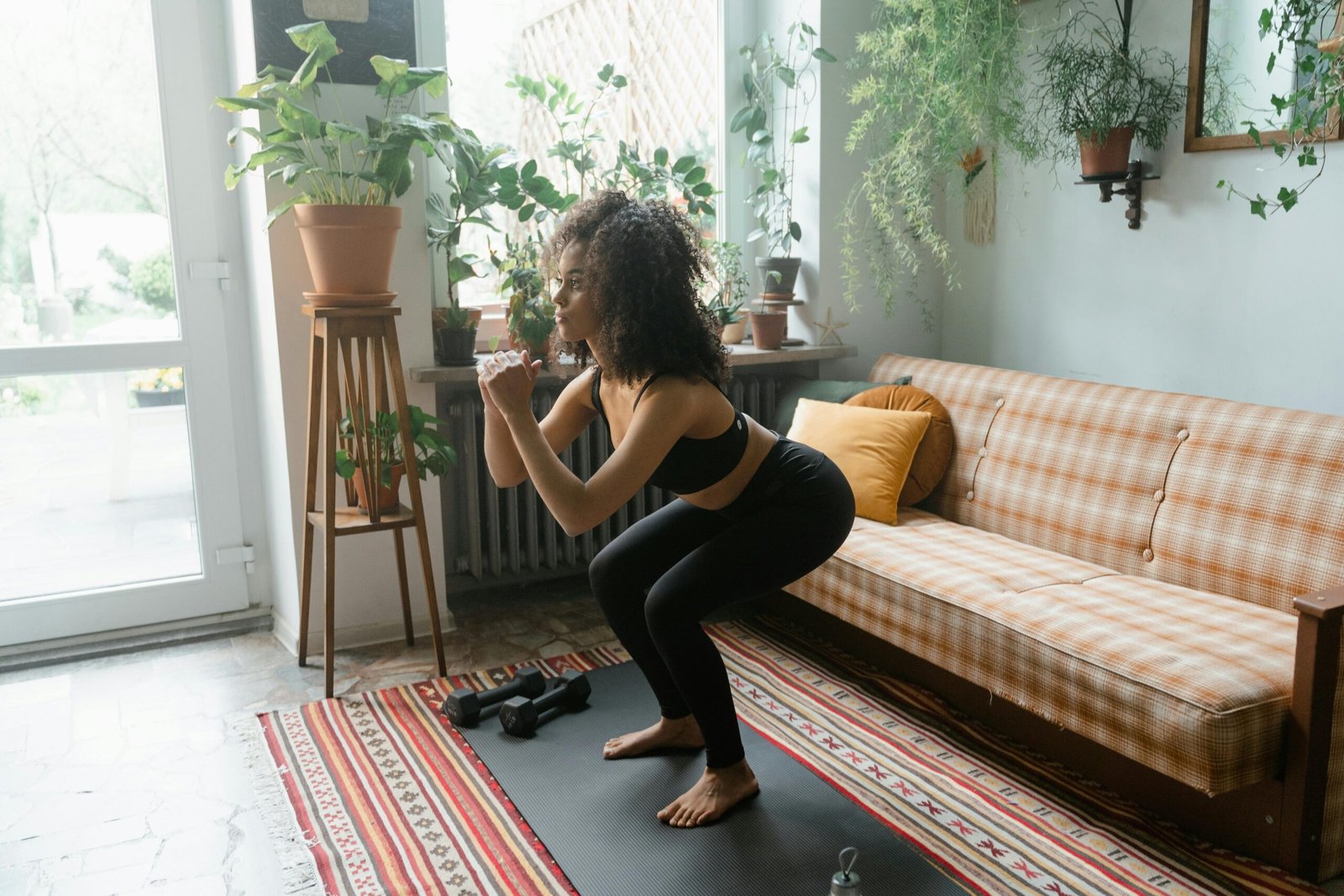
Or, if you have less time, do some squats while you’re putting away the dishes, or squat while brushing your teeth before going to work/school.
Use an already established routine or action in your day as the cue to start a new habit: moving.
It can be super short, just 5 minutes, or 30 squats, or jumping jacks for 30 seconds.
You can adjust it to how much time you have and how often you can do it.
2. Do 5 minutes of strength training exercises while waiting for your coffee/tea to brew
When we exercise in the morning, we are setting ourselves up for success.
Right after waking up, our cortisol peaks. Cortisol has a bad rep as the “stress hormone”, but that is not all it’s responsible for.
Cortisol gives you energy to get up and move around in the morning (even if you don’t always feel like it, it is still there).
Use this little boost, and give yourself a boost by doing a short strength training routine in the morning.
Getting ready takes time, so optimize it by doing it while you’re waiting for the kettle to boil, or the coffee to brew, or while you’re waiting for the water in the shower to heat up.
Having a short strength training routine in the morning doesn’t just give you the physical benefits, but also the mental benefits.
If you do this in the morning, even for 3 minutes, you’ve already completed a task! You’ve already succeeded at something!
This shows you that you can rely on yourself, that you can trust yourself to get the other tasks of the day done as well.
Here’s a very simple routine that takes less than 5 minutes:
- 30 squats
- 30-second plank
- 30 reverse lunges (15 each leg)
- 30 push-ups/wall push-ups
- 30 standing bicycle crunches
3. Put on some music and dance while doing the chores
We often think of movement as a chore, but it doesn’t have to feel that way.
Have fun!
Move around without feeling like it’s a chore.
Use movement as a way to distract yourself from other tasks you don’t like.
Being together with others and having a good time is so essential to our mental health.
And what better way to do that than to have a little dance-off in the kitchen?
Be silly, make big moves, go all out.
And, even if you’re by yourself. Dance!
It’s the simplest way to be active and to instantly feel happier.
4. Actually TAKE THE STAIRS.
You’ve read this a hundred times, you’ve heard it a hundred times, and you’ve probably said it a hundred times: “From now on, I will take the stairs at work”.
It’s okay that you haven’t yet, and it’s okay that you quit, but it’s time to pick it up.
Here are three tips to *actually* take the stairs at work/school.
1. Make it a challenge with someone else
Having a partner makes you accountable for your actions. This increases the chances of you succeeding at a challenge exponentially.
Even if you forget, or don’t feel like taking the stairs, knowing that someone else will ask you how many flights of stairs you walked at the end of the day is usually motivation enough to take the stairs at least once.
2. Start easy
You don’t have to walk to the 12th floor on the first day if that’s where your office is.
Just walk up until you feel like you’re getting tired or starting to sweat, and then take the elevator the rest of the way.
If that’s the 2nd floor? Great. You walked up a flight of stairs today.
If that’s the 5th floor? Awesome. Keep it up!
3. Keep track of your progress, so that you can celebrate
Maybe you were able to walk up 2 flights of stairs on day 1, and on day 10, you walked up 5 flights of stairs.
If you keep track of these developments, it will keep you motivated.
Becoming more fit, getting more endurance, and becoming happier in the process these are all reasons for celebration.
5. Get off one stop early from the bus/train if feasible. Or park your car five minutes further away.
Depending on where you live, the amount of walking you do can be vastly different from someone else.
If you live in the US, it’s extremely likely that you drive everywhere, and almost never walk (except for in stores).
Whereas if you live in a big city with public transportation, you probably take that everywhere, and walk more from station to station.
In either case, you can easily increase the distance you walk by doing a simple thing.
Park further away, or get off public transportation one stop early.
Instead of walking 3 minutes from the car/train/bus to your work, now you might have to walk 8 minutes to get there.
How awesome is that!
And no excuses on the way home, because if you don’t walk, you won’t get to your car.
Just these 10 minutes a day, add up to at least 50 minutes of extra movement a week.
Now imagine you do it everywhere you go: the office, the store, the gym, …
All these short periods of movement that feel so feasible can increase your physical activity by a LOT, and will eventually make you feel better and healthier.
Incorporating these simple habits into your daily routine can transform your health and happiness without feeling like a chore.
Start small, stay consistent, and watch the physical and mental benefits stack up!
For more practical health tips and creative ways to stay active, subscribe to our newsletter.
Get great advice and motivation delivered straight to your inbox to keep you motivated and moving toward a healthier you!
And remember, it takes small steps to achieve great balance!
Feeling curious? Check out some of these interesting articles!
Myers, J. (2003). Exercise and cardiovascular health. Circulation, 107(1), e2-e5. https://www.ahajournals.org/doi/full/10.1161/01.CIR.0000048890.59383.8D
Green, D. J., et al. (2017). Exercise and vascular function. The Journal of Physiology, 595(12), 3611-3620. https://pubmed.ncbi.nlm.nih.gov/28151424
Lavie, C. J., et al. (2019). Exercise and the cardiovascular system. Journal of the American College of Cardiology, 73(10), 1206-1218. https://www.ahajournals.org/doi/full/10.1161/CIRCRESAHA.117.305205
Garber, C. E., et al. (2011). ACSM position stand: Quantity and quality of exercise. Medicine & Science in Sports & Exercise, 43(7), 1334-1359.https://journals.lww.com/acsm-msse/Fulltext/2011/07000/Quantity_and_Quality_of_Exercise_for_Developing.26.aspx
Lesinski, M., et al. (2015). Effects of balance training on balance performance in youth. Sports Medicine, 45(12), 1721-1738. https://link.springer.com/article/10.1007/s40279-015-0375-y