

Are you already feeling behind, even though the year just began?
Do any of these sound familiar?
- You feel like you’re slacking.
- Your goals and dreams are big, but they seem impossible to achieve.
- You believe in yourself, but are scared of failing once again.
- You don’t believe in yourself.
- Your dreams and goals scare you.
- You think the only way to get where you want to be is by being perfect.
- You think being perfect once a week is more important than showing up consistently.
Let me tell you this: You’re not the problem. Your game plan is.
And we’re here to help you fix it!
This blog post isn’t just about how to achieve set goals.
It’s also about how you know you’re making progress.
It’s also about staying motivated throughout the year.
It’s also about getting back on track after you’ve had a rough day, week, or month.
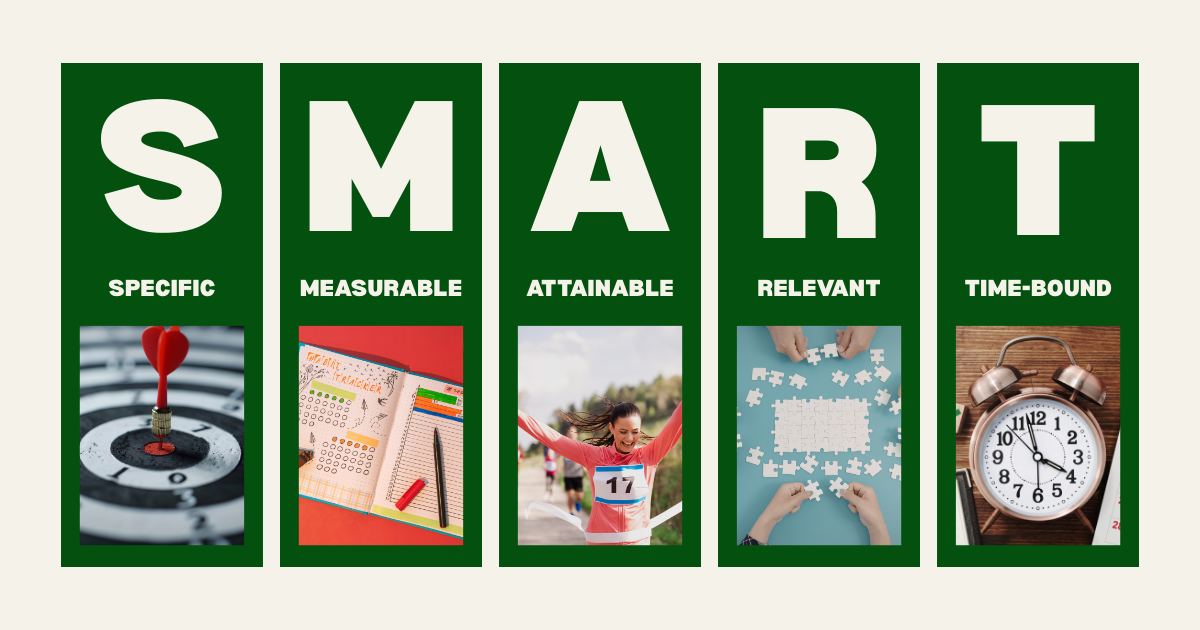
Today, we will be SMART with our time, goals, and intentions and apply a 5-step framework to achieve any set goals.
Why Setting SMART Goals Is Your Life-Saver
Have you ever set New Year’s Resolutions?
Maybe one (or more) of these sounds familiar.
In 202X I want to
- Get fit
- Travel more
- Improve sleep quality
- Have a good routine
- Learn a lot
- Read more
- Make friends
These goals, by themselves, sound pretty awesome.
But if you start thinking about it, how will you ever know you’ve achieved any of them?
How will you know if you got fit?
How do you know if you have better sleep quality?
How do you quantify learning?
That’s where SMART goals come in.
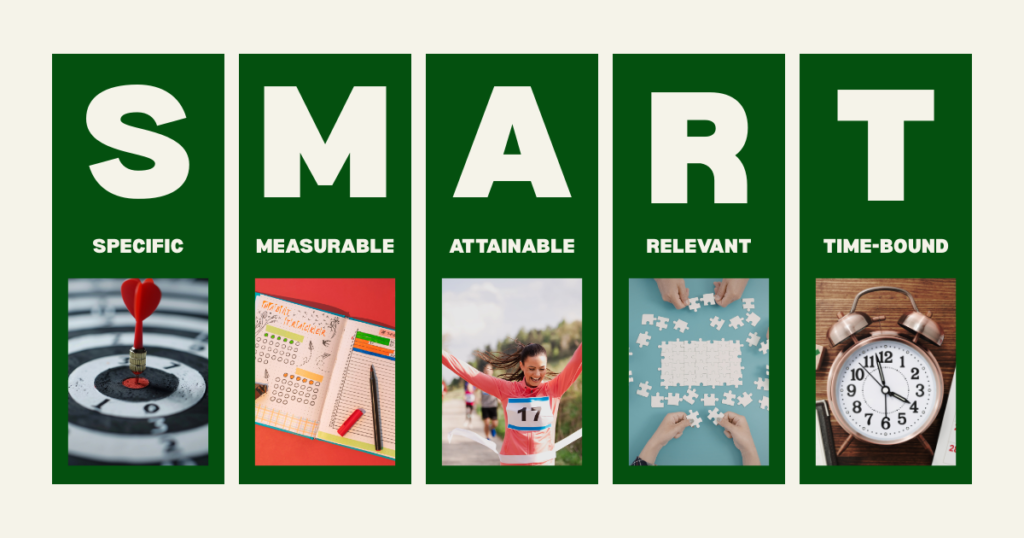
SMART stands for specific, measurable, attainable, relevant, time-based.
We need to first figure out our current status, decide where we want to end up in the future, and then we’ll actually know when we’ve achieved our goals.
Step-by-Step Guide to Your 5-Minute SMART Goal Hack
This might seem overwhelming, but really, it is going to change your life.
If you’re unsure what goals you would like to work on first, use this blog post to figure out your priorities.
Get ready
Find some time in your day to sit down and focus on setting SMART goals.
Grab a notebook and pen, or prepare a digital document.
For the next five minutes, think of one key area (health, career, relationships, mindset, etc.) you want to improve.
Step 1 – S for Specific
Start by writing down the broad wish or goal you have in one of the categories.
Here are a few examples:
- Become more fit
- Improve relationships
- Learn Spanish
- Read frequently
Now think about how you can make this goal more specific.
Such as:
- Be able to run 5 miles.
- Become better at active listening, not interrupting people, and communicating more clearly.
- Learn 150 Spanish words and 10 different sentence structures.
- Read 20 books.
Step 2 – M for Measurable
Now that you’ve specified your goal, we will try to make it measurable.
Some goals in the example are already measurable, such as being able to run 5 miles or read 20 books.
If your goal still feels kind of vague, or you’re not sure how you would be able to measure it, you can always try to be as specific as possible, or add a time-goal.
Maybe you want to read a lot, but the number of books doesn’t matter to you.
In that case, you can say you want to spend X amount of hours a week on reading books.
You can also aim to achieve a habit, such as doing pilates 4 times a week, or going for a 15-minute walk daily.
Step 3 – A for Attainable
Before starting to work on these goals and adding them to your calendar, make sure that the goals you set are attainable.
One of the biggest reasons people do not achieve set goals is simply that they do not actually have the time to complete the goals they want to complete.
How can you make sure your goals are attainable?
- Evaluate or estimate how much time you have to work on the goal.
- Change a deadline for a goal if you don’t think you’re going to have enough time.
- Make sure the goal aligns with your values and/or daily routine.
Making sure your goal is attainable doesn’t mean that you cannot set a ridiculously big, hard-to-achieve goal.
Just make sure you actually have the time and tools to give your goal the energy it deserves.
Step 4 – R for Relevant
Setting a goal and spending a bunch of time on it is not a small thing, so before diving in too deep, it’s important to confirm that you set a goal that aligns with your values.
To find if a goal is relevant, you need to think about the big picture.
What are you working towards?
Where do you want to end up?
If your goal aligns with that dream and acts as a stepping stone or the whole plan for it, it is definitely relevant.
We’ll give you an example.
Imagine someone loves baking and wants to become a high-end wedding cake baker with a big clientele.
They already have a small business, but are trying to find ways to grow and get more clients.
A relevant goal for them would be “to design and launch a new, premium ‘Bridal Tasting Box’ package”.
A non-relevant goal would be “to share funny videos about some ridiculous baking tools that don’t work on TikTok”, because this goal does not help them become a high-end wedding cake baker with a big clientele.
Step 5 – T for Time-bound
We’re almost done, hang in there!
If we don’t set a time by which we want to achieve a goal, can we really achieve set goals?
Any goal, small or big, can have a deadline.
Maybe you can only afford to spend 1 hour a week working on a certain goal; this might push your deadline further into the future.
Or maybe you suddenly have a ton of time, giving you the freedom to achieve your goal quickly.
Step 6 – Put everything together
Now that you’ve collected the 5 pieces of your SMART goal, it’s time to put them all together.
Once you’ve done, that it will look something like this:
“I want to attend three 30-minute online fitness dance classes per week for the next 6 weeks to improve my mood. I will track my mood in a mood tracker that I created in my bullet journal, and see how the dance classes improve it over the course of 6 weeks.”
Or
“I want to spend less time on Instagram scrolling through videos. I will do this by tracking how much time I spend on it daily and not allowing myself to spend more than 30 minutes a day on it. Whenever I feel the urge to scroll on Instagram, I will do something else that gives me satisfaction, such as doing squats, going for a walk, reading a book, or drawing.”
Tips to Achieve Set Goals
Before we end this quick guide on how to achieve set goals, we want to give you some additional tips.
- Keep it to 1-3 goals when you’re starting out, so that you can get used to the process and not feel overwhelmed.
- Review and refine: revisit the goal if you feel like it’s not working out for you. Tweak some details, such as when you’re dedicating time to work on it, or postpone the deadline.
- Make it visible:Place the written goal somewhere you’ll see it daily (phone wallpaper, fridge, planner).
- Keep it attainable: You can set ambitious targets, but just remember that “achievable” is a key part of the strategy.
A clear strategy makes all the difference in achieving set goals.
Keep showing up and keep getting better.
But don’t forget you need to rest when you’re tired.
Sign up for our newsletter to receive more tips on productivity, goal-setting, and so much more!
Not done reading yet?
Use powerful affirmations to master your goals
Master success in productivity with the FOCUS method